Monday, February 14, 2011

Dawson’s Game & Trout Lodge

Dawson’s Game and Trout Lodge, a unique African experience, is situated in Mpumalanga where the last remnant of the Great Rift Valley forms the Escarpment, separating the High- and Lowveld with their dramatically different climates, flora and fauna.


Dawson’s lies at the transition of these two regions, where Highveld Blesbok meet Lowveld Impala, with dramatic mountain backdrops forming perennial streams and waterfalls that is the Komati River. Explore at you leisure over 2000 hectares of wide open grasslands and bushveld, teeming with herds of antelope.

They accommodate sixteen guests in eight rooms; all of our facilities are of the highest standard, so that a stay with us is more like a country house party of yesteryear. For the mature and more thoughtful guest to relax and contemplate the qualities of life, that here, make a truly splendid place.

Accommodation

EN-SUITE ROOMS

Eight luxurious en-suite rooms with large Victorian-style bathrooms. All of our facilities are of the highest standard, large suites with dry-stone interior walls, percale linen, king size 4-poster beds, hand-picked antique furniture, fireplaces, sherry and nuts, walk-in closet, heated towel rails, fully stocked mini-bars with Dawson’s home-made chocolate chip cookies as well as freshly ground coffee.

Dining

Marvel at our chef’s innovative talent while you sit back and soak up the atmosphere, savouring the taste and aroma of cuisine in its most exquisite form. Breakfast and lunch can be served either in the privacy of your own room, on the patio or enjoyed in our dining room.


For a romantic lunch, our chef will prepare a sumptuous picnic basket that can accompany you on a self-drive outing to any secluded point on the reserve. Finally, for a truly African experience, dinner can be taken in our traditional African-style boma, around an open log fire.

Conferences & weddings

Dawson’s Game & Trout Lodge offers 2 Conference Venues each offering boardroom seating for 12 delegates, cinema 30, u-shape 15 and schoolroom seating for 20. We specialise in intimate weddings and exclusive functions.

Dandy-line spa

Dawson’s Game and Trout Lodge now offer their guests spa treatments that focus specifically on de-toxification and de-stressing in an inspiring environment. Stiglingh, a renowned therapist whose treatments embody her “All natural, all hands on” approach. Lengthy treatments beside the fireplace in the privacy and warmth of a guests cottage or outside on the grassland plains under the aloe trees, are filled with scents of peppermint, ginger, camphor, lemon verbena, coffee and vanilla.

Activities

Guests have full access to a variety of activities while staying at Dawson’s Game and Trout Lodge. These include guided game drives and walks, trout and bass fishing, bird viewing, horse riding, scenic hikes or just simply relax around our pool area and soak up the magnificent sunshine and views.

BASS AND TROUT FISHING:

While away the hours doing what comes naturally from our well-stocked waters or let us offer you expert tuition.

BIRD WATCHING:

The area hosts a unique combination of bird species such as Knysna Lourie, Malachite Hum bird, Olive Bush-Shrike, Trumpeter Hornbill and many more occasional visitors and seasonal migrants. Spending a few hours in our corner of paradise accompanied by a professional field guide will offer constant excitement and photographic opportunities.

HIKES AND WALKS:

Revitalise your spirits with a short guided or free walking day - walk along 100-year-old water canals to a spectacular waterfall overlooking the valley.

HORSE RIDING:

For the adventurous there can be no better way of getting up close and personal to our wildlife.

GAME VIEWING:

Early morning and late afternoon guided game drives will thrill you across wide-open grasslands and through dense bushveld. Experience the unique behavioural patterns of our myriad of wild indigenous game species whilst enjoying your favourite sun downer.

SIGHTSEEING:

Dawson’s Game and Trout Lodge, is situated in Mpumalanga (meaning “the rising sun”) which is well known for its spectacular scenery, wild life and historical interest. Exciting day drives can be taken to nearby Barberton, Pilgrims Rest (Discovery of Gold - Gold Rush), Graskop, Sabie and Swaziland, as well as the Kruger National Park.

Sunday, February 13, 2011

The Wild Coast

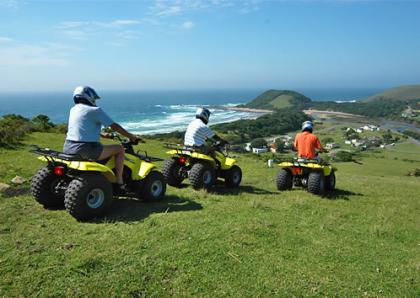
The Wild Coast, as its name suggests is rugged and treacherous, with numerous shipwrecks along its deserted beaches. It is the heart of unspoilt rural South Africa, almost untouched by time and particularly untouched by the infrastructure that the rest of South Africa is accustomed to.


This is because it was a black homeland within apartheid South Africa that was not deemed worthy of development. Today it remains a poor area dotted with villages of traditional mud and thatch huts. Cattle are grazed on the grasslands and the land is toiled by hand and oxen to provide a subsistence living.


The essence of the Wild Coast is that nothing happens in a hurry, which is definitely the case in the small coastal towns of Port St Johns and Coffee Bay. Several lodges have sprung up along this coast to afford visitors a glimpse of the lovely scenery along the rocky coastline interspersed with long empty beaches. There are still patches of thick forest and some remote coastal reserves with unique flora.

A notable resident of this region is the illustrious Nelson Mandela, who comes from the inland village of Qunu near Umtata.


NATURAL HISTORY

Wildlife is sparse along this stretch even though great tracts of the coast are deserted. The reserves have been created mainly to preserve the indigenous flora, such as the endemic Pondo coconut palm in Mkambati Nature Reserve.

If you venture along the coast you are certain to see fish eagles as they perch on the skeletons of wrecked ships. In the vegetated and wooded areas the birdlife is prolific.

WILD COAST GAME RESERVE SPECIALTIES

· Remote rural Africa
· Endless coastline
· Shipwrecks
· Fishing
· Hiking or horse riding along coastal trails

Face and Body #1


Saturday, February 12, 2011

Monkey Valley Resort


Nestled amongst ancient Milkwood trees and overlooking 8 kilometres of Noordhoek beach is Monkey Valley Resort. A world apart from city living yet only 25 minutes to the centre of Cape Town – Monkey Valley Resort is an atypical splendour tucked onto the southern slopes of Chapman’s Peak Drive.


The resort offers a blend of self-catering old world log and brick thatched luxury cottages and bedrooms. Each is hidden in private alcoves within the rare milkwood forest, ensuring complete seclusion.

The range of units has a peaceful ambience with uninterrupted vistas across the Atlantic ocean or the mountainous magic of Chapman’s Peak. Accommodation can cater for families, groups, couples or individuals.

At the heart of the resort is the treetop pub and open deck- forever popular for evening sunsets and chilled sun downers of choice and a meeting point for guests and locals. The ambient sun warms the wooden panels of Thorfynns Restaurant, a natural preference for divine dinners and wonderful wines and a short stroll from your bed.


A healthy farmhouse breakfast will prepare anyone for the myriad of activities available from Monkey Valley Resort. From beach walks to horse riding, lazy days around the swimming pool to hiking the mountains, the welcoming and efficient staff can point you in the right direction or arrange your daily activity.

A log thatch treetop hall with open deck is available for year end functions (and is an ideal winter conference location too). Choose your theme or ask us to arrange your entire function and do enquire about package options.


Best Review - Top 5 Sites That Pays You To blog

Thursday, February 10, 2011

Umhlanga Coast, KwaZulu-Natal


Only a short drive from Durban, the Umhlanga Coastline begins more or less at the landmark lighthouse that dominates Umhlanga’s beach. From here, the long, sandy beaches are a cosmopolitan collection of white hotel buildings and blocks of timeshare apartments that easily signify the lifestyle sought by many on this incredible stretch of coast, that is at once a tourist mecca and a seaside village that has refused to lose its small town appeal.


Umhlanga, La Lucia, Mount Edgecombe and Umdloti all nestle alongside one another in a string of first rate beaches and suburbs that not only include a beach of blue flag status, but are collectively some of the most popular beach resort destinations on the east coast of South Africa. It isn’t hard to imagine why, given the warm Indian Ocean waters, the rocky lined beaches that allow for plenty of seaside paddling and shell searching, and attractions like O’Connor promenade - a walkway that stretches from Durban View Park to Breakers Resort - that is constantly used by an array of walkers, joggers and amblers.


The Umhlanga Coastline is also host to numerous pubs, restaurants, shopping centres and a ‘happening’ nightlife that only enhances the appealing coastline already popular with scuba divers, snorkelling fanatics and surfers. Within a very small area there are action-packed attractions that include the Umhlanga Lagoon Nature Reserve where the remains of a shell midden from the Stone Age is in evidence at the mouth of the lagoon; the Hawaan Forest - a beautiful indigenous woodland that has been allowed to maintain its natural state for centuries; the Beachwood Mangrove Nature Reserve, and various dive sites.

Wednesday, February 9, 2011

South African Birdlife


South Africa ranks as one of the top birding destinations in the world. An incomparable combination of variety of birds, first class South African hotels and accommodation facilities, an excellent network of internal airline routes and a multitude of South African car hire companies (including the large internationals) and a supportive avi-tourism industry makes South Africa one of the most desirable birding destinations in the world.

Birders from around the world come to experience both the great variety of typically African birds, migrants, and Endemic Birds. These birders enjoy excellent birding, whether they are with an organised commercial birding tour or are touring independently. Of the +/- 850 bird species recorded in South Africa, about 725 are resident or annual visitors, and 50 of these are endemic or near-endemic and can only be seen in South Africa. Apart from resident birds, South Africa hosts a number of intra-African migrants such as cuckoos and kingfishers, as well as birds from the Arctic, Europe, Central Asia, China and Antarctica during the year.

KWAZULU NATAL


The north-eastern part of KwaZulu Natal is one of the most species-rich areas of South Africa with a tropical feel and spectacular birds. Lush forests, marshes, freshwater lagoons, flooded grasslands, tidal estuaries and acacia woodland support an excellent array of birds. Specials of the area include Woodward's Barbet, Palmnut Vulture, African Broadbill, Neergaard's Sunbird, Rudd's Apalis, Delegorgue's Pigeon, Knysna Turaco, Livingstone's Turacos and Southern Banded Snake Eagle.

Birding facilities are exceptionally well developed in this region. The Zululand Birding Route is centred on Eshowe. Dlinza Forest in Eshowe has a forest boardwalk that takes you into the canopy from there you can observe species such as Delegorgue's Pigeon, Grey Cuckooshrike, Crowned Eagle and Spotted Ground Thrush.

WESTERN CAPE


The Western Cape is a much visited region with excellent birding and superlative scenery, the best whale-watching in the world and the possibility of seeing Great White Sharks. Apart from the pelagic trips which are good all year but best in winter, the Western Cape hosts a large number of endemics and the best wader watching in the country. The endemics include fynbos specials such as Orange-breasted Sunbird, Cape Sugarbird, Cape Siskin, Protea Seedeater and Hottentot Buttonquail. Cape Rockjumper is found on the craggy mountainsides. Knysna and Victoria's Warblers can be seen in the damper valleys and a variety of larks in the dry interior.

The West Coast National Park (which includes the Langebaan Lagoon) attracts massive numbers of waders from their Arctic breeding grounds during the southern summer and is particularly important for the Curlew Sandpiper. The Langebaan Lagoon is surrounded by the strandveld where Black Harrier, Southern Black Korhaan and a variety of smaller birds such as Grey Tit, Cape Penduline Tit and Layard's Titbabbler can be seen. Closer to Cape Town the Cape of Good Hope National Park offers excellent birding for species such as Hottentot Buttonquail and a variety of seabirds. The nearby Boulders Beach National Park at Simonstown has a flourishing African Penguin colony.

MPUMALANGA

The Lowveld is the low-lying tropical region in the north-eastern part of Mpumalanga largely taken up by the famous Kruger National Park and is bordered in the west by Drakensberg escarpment. These low-lying bush areas are home to large populations of South Africa's Wildlife and birds typical of such South African Reserves.

Raptors occur here in good numbers including Martial Eagle, Tawny Eagle, Brown Snake Eagle, African Hawk Eagle, Walhberg's Eagle, Steppe Eagle and Lesser Spotted Eagle. Other large and noticeable birds include Saddlebilled Stork, Southern Ground Hornbill, Ostrich and Kori Bustard. Along the western edge of the Lowveld the escarpment supports many forest and cliff dwellers including Taita Falcon, Bat Hawk and Cape Parrot.

The Central Grasslands are a key area for birders holding a number of special grass- and wet- land species. One of the most visited towns is Wakkerstroom which is close to where Mpumalanga, the Free State and KwaZulu Natal Provinces meet. Wakkerstroom is visited by most of the birding tours that come to South Africa and as a result has excellenent birding facilities including resident tour guides.

GAUTENG


Even though Gauteng is the most heavily developed area in South Africa, Gauteng offers excellent birding. Around 350 different bird species can be seen within easy reach of Johannesburg and Pretoria, and a wide range of habitats are easily accessible. Of primary interest are Marievale, Suikerbosrand, the Magaliesberg Mountains, Walter Sisulu National Botanical Gardens and the Dinokeng Bushveld area. Even within cities a great variety of birds may be found, and garden lists often exceed 100 species. Common species include Hadeda Ibis, Speckled Pigeon, Grey Loerie, Bokmakerie, Green Woodhoopoe, Black-collared Barbet, Olive Thrush and Cape Robin.

Tuesday, February 8, 2011

Kosi Bay


The Kosi Bay Nature Reserve is situated on the coast in the northern part of KwaZulu Natal and surrounds the Kosi Bay lake system. The system consists of four lakes and a series of inter-connecting channels which drain via a sandy estuary into the Indian Ocean. It is home to a variety of birds and wildlife including hippopotamus and crocodile.

This is the most pristine lake system on the South African Coast. The 11, 000 hectare Kosi Bay Nature Reserve is a tropical paradise of crystal-clear blue water and marshland, raffia, wild date and palm, mangrove swamp and sycamore fig forest that combine to provide a home for approximately 250 species of bird, among them the fish eagle and palmnut vulture, white backed heron and the night heron as well as purple and reed kingfisher.


Bushbuck, duiker and monkey inhabit the forested parts whilst hippopotamus and crocodile bask in and around the lakes and fish teem beneath their surfaces. Humpback whales can be seen off the beaches on their northerly migration to calve in Mozambique and in December and January loggerhead and leatherback turtles come onto the beaches to lay their eggs in carefully prepared nests.

Please be aware that Kosi Bay is a high risk malaria area and visitors are advised to take precautions. Please consult your Doctor or Pharmacist about malaria prophylaxis prior to visiting the Kosi Bay Nature Reserve.


Monday, February 7, 2011

Coffee Bay

In the heart of the Wild Coast is Coffee Bay, a small inlet near Mthata with only a grocery store, post office, and a few Bed and Breakfast establishment and backpackers to its name.


 The destination largely appeals to students and the young at heart, and the nightlife consists of drumming circles and the occasional trance parties.


What Coffee Bay boasts of, however, is some of the best surfing in South Africa along with spearfishing, scuba diving, and swimming, on an unspoiled stretch of coastline. There is fishing to be done, and you'll likely spot dolphins, whales, and the occasional Cape Clawless Otter.


The area is a paradise for hiking, horseback riding and golf. Although distinctive landmarks are few, don't miss the iconic Hole-in-the-Wall, a remarkable rock that has had a giant tunnel carved into it by the sea.

This is paradise! This is a must see to appreciate!!